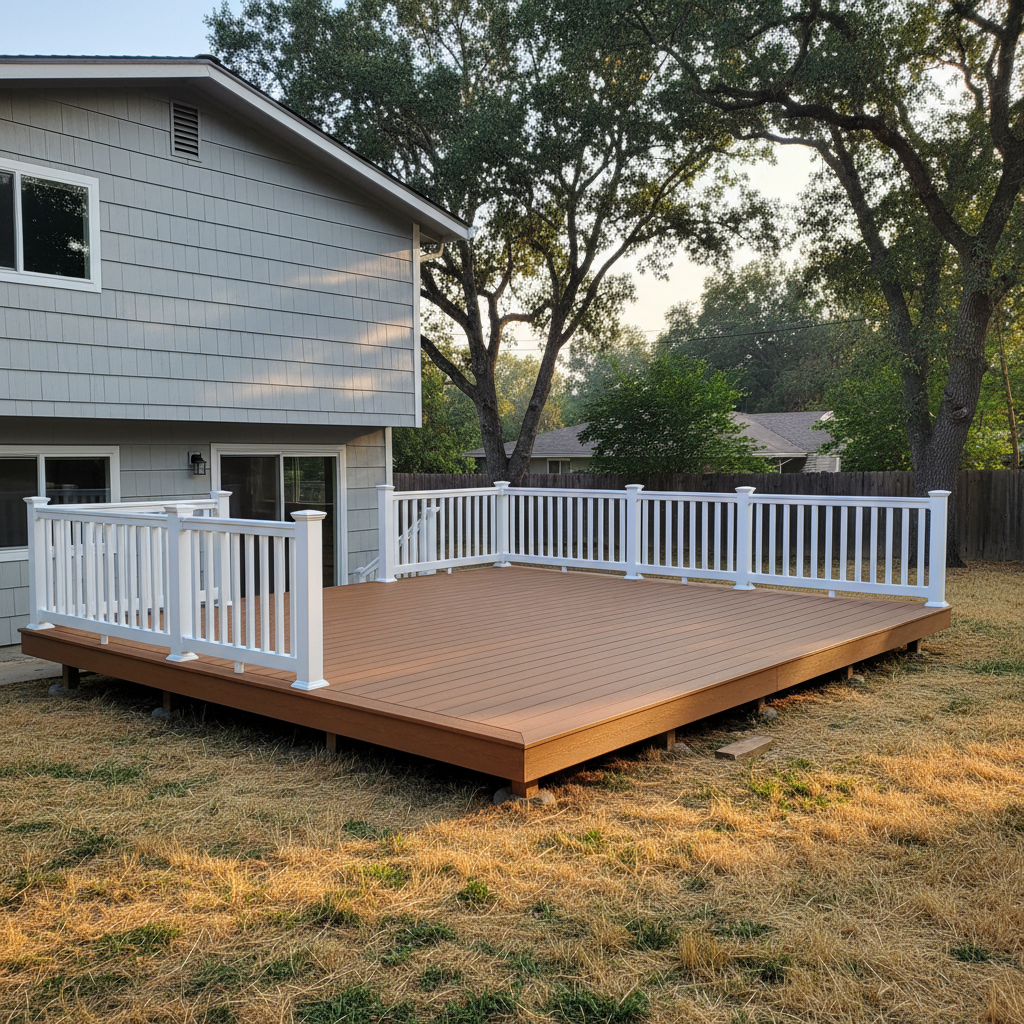
Escondido sits in a valley with clay soil that most people never think about until a deck starts to lean. That clay expands when the winter rain soaks it and shrinks hard when the summer heat dries it back out, sometimes by an inch or more across a season. A deck footing that isn't poured deep enough, or isn't belled out at the bottom, will move with that soil. You won't see it the first year. You'll see it in year three when the railing starts to rack and the stairs stop sitting flush. Any builder you talk to should bring this up without you asking.
So picking a deck builder here isn't just about who answers the phone fastest or has the nicest truck wrap. It's about whether they build for this ground, this heat, and the way the City of Escondido actually inspects this kind of work. Here's what to look at before you sign anything.
What the ground and the weather actually demand
Footings around here generally need to go at least 12 to 18 inches deep, and in clay-heavy lots a good builder will go deeper or widen the base of the footing so frost heave isn't the issue, expansive soil movement is. If someone quotes a deck without mentioning soil at all, that's worth noting.
Summer heat is the other factor. Escondido regularly sits in the 90s from June through September, with low humidity and strong sun. Wood decking dries out fast under that, which causes cupping, checking, and splinters within a season or two if it isn't sealed on schedule, usually every 12 to 18 months for most softwoods. Composite decking doesn't crack the same way, but it does expand and contract more than people expect, sometimes a quarter inch or more across a 16-foot board between a cold January morning and a 100-degree July afternoon. Gaps between boards need to account for that or you'll get buckling at the seams. A builder who's worked composite here knows the manufacturer's gapping spec by heart. One who doesn't, guesses.
If your property is in or near a higher fire-hazard zone, which covers parts of the hills around Escondido and out toward Valley Center, ask whether the decking and under-deck materials meet Class A fire ratings. Not every contractor will know this off the top of their head. That's a red flag on its own.
What a real bid includes
A proper quote should name the footing depth, the post size, the joist spacing, and the fastener type. Joist hangers and structural screws should be stainless steel or hot-dip galvanized, not the cheap electroplated kind that starts rusting within a year or two of coastal humidity swings. Ledger board attachment matters more than almost anything else on the job, since that's the connection holding the whole deck to your house. It needs proper flashing behind it to keep water from running into your rim joist, and it needs to be through-bolted or lagged into solid framing, not just screwed into siding.
Ask what joist spacing they're using. 16 inches on center is standard for most decking, but composite often calls for 12 inches on center to avoid sagging between boards over time, check the manufacturer's span table rather than assuming it's the same as wood.
A detailed quote takes a little longer to put together than a one-line number scribbled on a business card. That's fine. You want the one that took longer.
Permits and inspections in Escondido
Most decks attached to the house, or any deck more than 30 inches above grade, need a building permit through the City of Escondido. The city will typically want to inspect the footings before concrete gets poured, and the framing before decking boards go down. Skipping this isn't a shortcut, it's a liability you inherit. An unpermitted deck can come up during a home sale inspection years later and become the buyer's bargaining chip, or your problem to fix retroactively.
If you're in a newer subdivision with an HOA, which covers a lot of the newer development around Escondido and its outlying communities, check your CC&Rs before design even starts. Some HOAs restrict deck height, railing style, or even stain color. A contractor who's worked in your neighborhood before will often already know this.
Older neighborhoods, like the streets around Old Escondido with homes from the early to mid-1900s, come with their own wrinkle: existing structures that were never permitted correctly to begin with, or additions built decades ago with framing that doesn't match current code. A deck tying into one of these houses sometimes needs extra structural work at the ledger connection just to get a safe attachment point. That's not a sign of a bad house. It's a sign the builder needs to actually look under the house before quoting, not just measure the back patio.
Red flags worth walking away from
- A quote with no mention of permits, especially for anything attached to the house or built above 30 inches.
- A price that's dramatically lower than two or three other bids for the same scope. Someone's cutting corners on footing depth, fastener grade, or lumber quality to get there.
- No written scope of what lumber, screws, or composite brand is being used. Verbal promises don't help you when something fails in year four.
- Reluctance to pull a soil sample or at least dig a test footing before quoting foundation depth on a larger deck.
- No mention of drainage. Water needs somewhere to go once it hits the deck surface and runs toward the house, especially during the heavier rain events in December through March. A deck that slopes the wrong way, even slightly, sends water right at your foundation.
Questions worth asking directly
Ask how deep the footings will go and why. Ask what fastener grade they use and whether it's rated for ground contact if posts sit in concrete. Ask who pulls the permit, them or you, and how they handle the inspection scheduling. Ask what happens if the inspector flags something, who eats that cost. A contractor who answers these without hesitating has done this enough times to know the answers cold.
None of this needs to be complicated once you know what to ask for. Our deck builder work at Titan Deck Co starts with the same questions above, whether it's a full rebuild, a repair on an older structure, or a new composite deck from scratch. Get a few quotes, compare what's actually written down, and pick the one that treats your soil and your climate like they matter. Because here, they do.